Concrete Mixers for Material Yards

Hey everyone,

It’s Daniel from Ready Mixer. 

Today I wanted to talk about adding our concrete trailers as a rental service for your material yard store. 

Our portable concrete mixers on trailers are a profitable service you can add to your material yards store. 

Our portable trailers range from

1 Yard

2 Yard 

3 Yard 

Ideally, your low-performing materials could easily be replaced with a mini-batch plant that would not take up a lot of room.

Once you are able to figure out your calculations on your low performing materials, you can do some projections on your revenue potential with a portable concrete trailer rental service in your area. 

Hopefully, this helps you get a new idea for potentially adding a new revenue stream for your store increasing your profitability.

As always if you need a quote 

Call: 800-770-3956

Email: sales@readymixer.com
 

Do you follow us on Social Media?

Hey everyone,

It’s Daniel here from Ready Mixer and I wanted to share that we have launched on different social media platforms. 

We currently are on facebook, youtube, and tik tok. 

You can find our pages here 

Facebook

Youtube

TikTok

Follow us and give us a like on each platform as we are looking to post more content on each platform of the equipment we offer. 

As always,

Eliminate Short Load Fees,

Eliminate Order Minimums,

Eliminate Wait Time

Request a Quote

Call: 800:770:3956

Email: sales@readymixer.com

Different Trailer Options

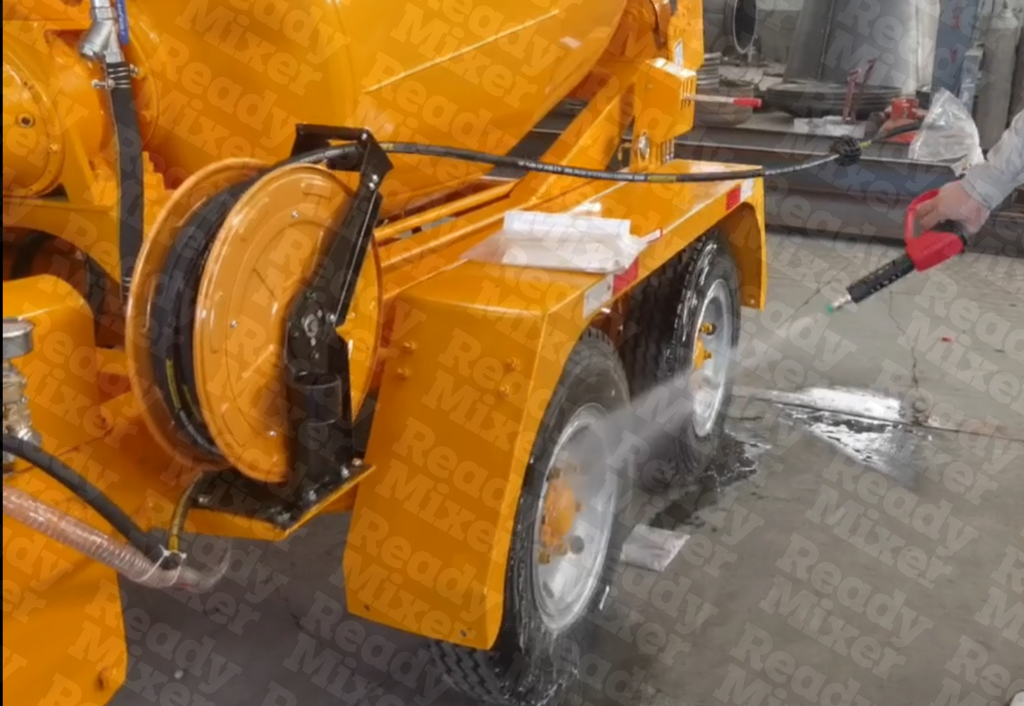
High-pressure sprayer attachment cleaning orange concrete mixer wheels during maintenance
Water Attachment for Mixers on Trailers

Hey everyone 

It’s Daniel from Ready Mixer.

Today I wanted to talk about our mixers on trailers.

Our mixers on trailers have a mixing capacity range from 1 to 3 yards.

They come with a lid cover to prevent spills on the road and are road-ready when you buy them. 

We equip each mixer with a Honda GX690 Engine that has 22 HP and an electric start.

Each mixer has a 12 volt battery and a kill switch for the power in case of an emergency. 

The mixers are simple to use with 2 levers, one for tilt and the other for rotation.

It is a dual-axle trailer with tires you can find at any local hardware store. 

Our pricing for trailers can range from 22,000 – 32,000 depending on the model you get. 

You can also buy separately the water attachment for cleanout purposes for the trailer.

The water attachment has a 50-gallon water tank and a water sprayer that is powered by hydraulics. 

The gross vehicle rate is different with each model. 

1 Yard on Trailer GVW is 6,800 lbs

1.75 Yard on Trailer GVW is down-rated to 10,000 lbs

3 Yard on Trailer GVW is 15,800 lbs 

Each trailer has a 2-inch ball hitch hookup. 

Hopefully, this helps you in the short-load concrete trailer buying process. 

As always, eliminate short load fees, eliminate order minimums, eliminate wait time,

Request a quote today!

Decorative Concrete

Glass Concrete Picture for Ready Mixer Blog Post
Decorative Glass Concrete

Hey everyone,

It’s Daniel from Ready Mixer. 

Today we are going to talk about Decorative Concrete.

Decorative Concrete was created when manufacturers started mixing different dyes in concrete to get different colored concrete. 

Brad Bowman who created stamped concrete introduced us to different patterns that resembled wood and tiles.

Decorative Concrete is used for a lot of residential projects to bring more life and aesthetics to driveways, parking lots, sidewalks, retaining walls, stairways, pool decks, public art, and playgrounds. 

There are different decorative designs you can go with such as stamped, colored, glass, epoxy flooring, pavers, and stenciled. 

The global decorative concrete market size is valued at 17.26 Billion USD in 2022 and growing at a 6% rate. The largest segment of decorative concrete is residential.

Charlie Chaplin, Groucho Marx, and Mary Pickford used a lot of decorative concrete for their houses in Southern California.  

Hopefully, this gives some insight into the decorative concrete market.

As always, if you have a lot of short-load concrete orders per year. Request a Quote and save money by buying a short-load concrete mixer. 

Cement Manufacturing

Cement Clinker Ready Mixer Blog Post Picture
Cement Clinker Nodules

Hey everyone,

Daniel from Ready Mixer here.

Today we are going to talk about cement manufacturing and how cement is produced. 

To start, cement’s raw materials are mined out of a quarry and consist of limestone, clay, and shale. 

They are then put in a kiln and heated to temperatures up to 1450 degrees Celsius to form clinker.

Clinker is a dark grey nodule or ball of heated limestone and clay from the kiln.

Clinker is then grounded and gypsum is added during the grinding process to finally form cement. 

Gypsum is a retardant used to slow the process of hardening for cement. 

The cement is a binding agent between sand and stone. 

There are different types of kilns such as rotary and shaft kilns. These kilns can be wet and dry process kilns. The difference between a wet and dry process kiln is that the wet kiln brings the meal wet into the kiln. The dry process kiln brings the meal hotter into the kiln. 

Whether you are buying cement in bulk or by the bag, I hope this helps you understand the process of how cement is produced. 

As always request a quote if you need short-load concrete mixing equipment. 

Concrete History and Facts

Hoover Dam Picture for Ready Mixer History of Concrete Blog Post
Hoover Dam Under Construction

Hey everyone,

It’s Daniel from Ready Mixer

Today I wanted to share some concrete facts and history with you. 

To begin, the first signs of concrete in history were from the Bedouins who had an empire in southern Syria and northern Jordan. They built concrete-like structures. 

The Egyptians also used mud mixed with straw to form bricks for the pyramids they built. 

China used a form of cement in building the Great Wall. Their ingredient was sticky rice. 

The Romans used cement and rocks to build houses. They also built the Pantheon and Colosseum out of concrete.

William Aspdin created Portland Cement when he left his father’s company to form his cement manufactory. 

The Alvord Lake Bridge was the first reinforced concrete bridge built in America. 

Colored Concrete was developed by the company L.M Scofield 

Brad Bowman developed stamping concrete which led to the creation of decorative concrete. 

Hoover Dam is made up of 4.36 million yards of Concrete which is still curing as we speak today. 

In the 1930s air-entrained agents were introduced into concrete to improve its resistance to freezing and cracking. The air bubbles relieve stress on the concrete which leads to fewer cracks in the concrete. 

I hope you were able to learn a few new facts on the history of concrete. 

As always if you need a concrete mixer for short-load concrete, request a quote. 

Mixer Production Rates

Production lineup of trailer-mounted concrete mixers with white drums and Honda GX690 engines
Manufacturing series of portable concrete mixers featuring dual-axle design and hydraulic systems

Hey everyone,

It’s Daniel from Ready Mixer

Today we are going to do a quick talk about our mixer production rates. 

Our mixers would be a great addition to remote projects in the mountains or on islands. 

One question I have got asked before was the production rate of our mixers if they were to run constant for a certain period.

This will be able to give you a good idea of whether our mixers are able to handle the capacity for the project. 

Our mixing rates are as follows for each machine:

1 Yard Mixer on Trailer can produce 4 yards per hour. 

1.75 Yard Mixer on Trailer can produce 8 yards per hour.

3 Yard mixers on a Trailer or Skid Rails model can produce 12 yards per hour. 

4 Yard mixers on skid rails can produce 16 yards per hour

5-yard mixer on skid rails can produce 20 yards per hour

6-yard mixer on skid rails can produce 24 yards per hour. 

9-yard mixer on skid rails can produce 36 yards per hour.

Based on these insights you can gauge which size you would need for your remote projects. 

Request a Quote, 

Shoot us an email at sales@readymixer.com or call us at 800-770-3956 

Mini Batch Plant Statistics

Portable 1-yard concrete mixer with green hopper system and tandem axle trailer setup
1 Yard Mixer on Trailer and Hopper

Hey Everyone,

Daniel here from Ready Mixer.

Today I wanted to share some statistics I have found from third-party research and talking to current mini batch plant owners about running a mini concrete batch plant. 

Some statistics I wanted to share with you are; how many yards of concrete the average mini batch plant produces per year, what the customer base of a mini-batch plant looks like, the average number of new customers that are acquired per year, daily sales volume, average profit margin to shoot for. 

To begin, the average mini batch plant produces 1700 yards of concrete per year while averaging 6.3 yards of concrete sold per day.

The average sale price of concrete is $155 per yard and profits are 50% or better. 

A good rule of thumb would be to shoot for a 50% profit margin to cover expenses and leave a good margin for yourself.  

The mini batch plant demographics consist of:

63% Contractors

31% DIY Customers

6% Municipalities

Of your customer base statistics:

32% use it every month

36% use the service every week

It is ideal to have good customer service as 84% of your customer base will be repeat customers.

On average there are 40 – 50 new concrete customers captured each year. 

It is also good to partner with your local big batch plant to handle the small orders as most see it as a loss to handle short-load orders. 

The reason why you will get orders is because contractors, DIY dads, or municipalities need 3 yards of concrete or less or they are pressed for time. 

Hopefully these statistics will help you in your buying decision to start a mini-batch plant in your area.

As always request a quote

Call: 800 – 770 – 3956

Email: sales@readymixer.com

Cement Storage Solutions

Yellow compact wheel loader displaying multiple attachments including material buckets and pallet forks
Wheel Loader with 1.75 Yard Mixer and Hopper in the background

Hey everyone,

It’s Daniel from Ready Mixer.

Today we are going to talk about Cement Storage Solutions and best practices for your mini-batch plant. 

Whether you are storing cement in a silo or by the bag, it is crucial to your concrete production and can immediately halt production if cement isn’t properly taken care of. 

To begin cement shelf life is three months and you should follow a first in first out basis on your cement usage. 

Cement should be stored in an area with no moisture. 

Cement also should not be stored in the heat or in an area where temperatures reach above 77 degrees Fahrenheit.

Cement should be stored away from other materials and covered with tarps to avoid moisture if you are storing it by a bag. 

Cement should be stored off the ground, which storing cement by a pallet in a shed or building is optimal for cement bags. 

Silo storage can eliminate manually carrying bags into the hopper, but clumping can occur in silo storage if not properly maintained which can halt your operations. 

Silo storage can help you save money by bulk ordering cement which lowers the cost of cement rather than buying it by the bag.

Your cement bag stacks should not be stacked any more than 15 bags high.  

There are different types of cement that you can use, the most common cement type is Portland cement, but there are others such as rapid-hardening cement.

Hope these tips help you in your batch plant operations.

As always, 

Eliminate short load fees, eliminate order minimums, eliminate wait time

Request a Quote today! 

Understanding Concrete Drying Time: What You Need to Know

Concrete drying time refers to the period required for moisture to evaporate from the concrete mix, allowing it to reach the desired strength and durability. Understanding this process is essential for ensuring the success of any concrete project.

Factors That Affect Concrete Drying Time

There are many chemical and physical changes that happen inside a concrete mixture as it is dries and cures. “When cement is mixed with water, rock-like crystals begin growing, giving the soon-to-be concrete its strength,” said Dynamic Concrete Pumping. Several variables can influence how quickly concrete dries and cures:

  • Temperature: Warmer temperatures accelerate the drying process, while colder temperatures slow it down.

  • Humidity Levels: High humidity retains moisture in the concrete, potentially slowing drying time, whereas low humidity can cause it to dry too quickly.

  • Water-to-Cement Ratio: A higher water content can extend drying time, while a lower ratio promotes faster drying and stronger concrete.

  • Aggregate Type: Larger aggregates slow down the drying process compared to finer aggregates.

  • Additives: Certain additives can alter drying times. Calcium chloride, for example, speeds up drying, while retarders like sodium sulfate and tartaric acid slow it down.

Recommended Concrete Drying and Curing Times

To ensure proper strength and durability, follow these general guidelines:

  • 24 to 48 hours – Safe for foot traffic.

  • 7 days – Adequate strength for light vehicle traffic.

  • 28 days – Full curing time for maximum strength.

Why Proper Curing Matters

Curing plays a vital role in ensuring the strength and longevity of concrete. “When most people think of curing, they think only of maintaining moisture on the surface of the concrete,” according to Concrete Network. “Concrete gives the concrete what it needs to gain strength properly.” It serves these important purposes:

  • Maintains moisture levels to support continued strength development.

  • Prevents premature shrinkage that can cause cracks before the concrete gains sufficient strength.

  • Enhances durability, water resistance, and wear resistance, ensuring long-lasting performance.

By understanding concrete drying time and following best practices, you can prevent premature cracking, enhance durability, and ensure your project stands the test of time.

Your business depends on precision and efficiency. At Ready Mixer, we help you get the job done right the first time with reliable, high-performance concrete equipment. When you need the best tools for the best results, trust Ready Mixer. Contact us today for expert advice and top-tier concrete mixing solutions!