The Science of Staying Warm

Written by Leigh Stadelmeier of RefrigiWear LLC.

Originally posted on ForConstructionPros.com on November 21, 2025.


Cold weather is one of the most underestimated jobsite hazards. Learn how to properly layer PPE to prevent heat loss, improve mobility and boost worker safety and productivity all winter long.

Key Points

  • How to fight 5 ways heat is lost by insulating and managing moisture

  • Use the 3-layer system of base > insulation > outer

  • Layer extremities & avoid overheating for safety.

Every jobsite has its hazards, but few are as underestimated as the cold. It creeps in quietly, draining focus and energy — until workers learn how to fight it with purpose. Despite the serious risk cold conditions pose on the job, many crews continue to layer up haphazardly, grabbing whatever looks the warmest without understanding the science behind thermal protection. The result? Reduced dexterity, overheating and lost productivity.


Staying warm isn’t about piling on more clothes. It’s about understanding how the body loses heat and building a system to prevent it. Layering PPE, the right way, allows workers to regulate body temperature, stay dry, and maintain mobility, even when conditions get tough.

How Does Heat Loss Happen?

The human body is designed to maintain a core temperature of roughly 98.6°F. When exposed to the cold, it constantly works to preserve that internal heat, but environmental factors can make the job harder.


The body loses heat through five key mechanisms:

  1. Radiation: heat radiates away from any uncovered surface.
  2. Convection: wind strips away warm air trapped near the skin.
  3. Conduction: direct contact with cold surfaces, like steel or concrete, pulls heat from the body.
  4. Evaporation: moisture from sweat draws heat as it evaporates.
  5. Respiration: each exhaled breath carries warmth away.

Protecting against all five forms of heat loss requires a balance of insulation, moisture management and wind resistance. When one layer fails — like when moisture builds up in the base layer — the entire system can collapse.

How to Layer Correctly for the Cold

Think of layering as building a wall against heat loss. Each layer serves a distinct purpose, and together they create a controlled micro-climate that supports both comfort and performance.

The Base Layer

The thermal base layer’s job is moisture management. It pulls sweat off the skin before it can chill the body.


Avoid cotton, as it soaks up moisture and traps it against the skin. Instead, workers should choose synthetic or wool blends that wick efficiently and dry fast. This layer should fit snugly, but not tightly, allowing full mobility while maintaining skin contact for proper moisture transfer.

The Heat-Trapping Insulation Layer

Once moisture is managed, insulation does the heavy lifting. Its job is to trap warm air close to the body. The key to insulation isn’t thickness — it’s trapped air. Synthetic fibers like down alternatives, fleece or advanced polyester hollow-core insulation create pockets of air that act as thermal buffers.


Workers in stop-and-start tasks, like operators or supervisors, need more insulation than those performing continuous heavy labor, whose bodies generate more heat.

The Protective Outer Layer

The outer layer must block wind and repel rain, sleet or snow while still allowing excess body heat to escape an being abrasion-resistant. Avoid overly tight or non-breathable shells as they can trap sweat, turning clothing damp from the inside.


Features like vent zippers, breathable membranes and adjustable cuffs can drastically improve temperature control.

Avoiding the Overheating Trap

Overdressing is one of the most common mistakes in cold-weather workwear — and one of the most dangerous. Instead, workers should:

  • Start slightly cool. Begin a shift feeling chilled. Body heat will rise within minutes of exertion.
  • Vent strategically. Unzip collars or underarm vents during high-activity tasks to release excess heat.
  • Layer for flexibility. Carry a removable mid-layer or insulated vest for easy adjustments.

Employers can also do their part by allowing short breaks for re-layering when conditions change. A small shift in temperature or workload can make a big difference.

Extending the Layering Logic

Heat is hardest to maintain in the extremities, where blood flow is naturally reduced to preserve core warmth. Layering principles apply here, too.

Hand Protection

In cold weather, a single pair of work gloves might not cut it. Adding a thin glove liner can wick moisture away from the skin and create an extra layer of warmth without sacrificing grip or dexterity.


Workers can adapt to changing temperatures by combining liners with insulated work gloves or swapping shells as the weather changes. For example, a thin, moisture-wicking polyester or wool liner worn under a waterproof work glove protects sweaty, clammy hands without adding unnecessary bulk. This two-part system lets workers maintain hand control without exposing skin or trapping sweat.


Concrete workers may also want to consider specialized chemical-resistant, insulated, and waterproof gloves for tasks like troweling, finishing, and washing down equipment, as wet cement/concrete can rapidly pull heat from the skin.

Head & Neck

Delicate skin around the face, ears and neck are particularly susceptible to frostbite. Hard-hat liners, balaclavas and neck gaiters built from breathable fleece or synthetic materials help retain warmth and protect these sensitive areas.

Feet

Moisture management is just as critical for feet as it is for the rest of the body. Wearing thin wicking socks under thermal wool socks, paired with insulated, waterproof boots, helps prevent both frostbite and trench foot injuries.

Matching Layers to Activity and Environment

Not all cold conditions are equal. Layering systems must adapt to both temperature and activity level.

RefrigiWear Chart on laying in cold weather
Source: RefrigiWear, LLC

Training workers to read their environment and adjust layers accordingly is one of the simplest and most cost-effective safety measures an employer can implement.

The Productivity Payoff

While warmth is critical for safety, it’s also a major driver of performance. Studies show that cold stress reduces dexterity, slows reaction time, and increases fatigue, all of which heightens the risk for accidents and injuries.


Comfort also directly impacts productivity. When workers are properly dressed, they can focus on the task at hand — not on how cold they feel. A well-designed layering system means fewer breaks to warm up, fewer distractions and fewer errors from numb fingers or stiff joints.

A Measured Approach to Protection

Layering isn’t just about adding more bulk — it’s about choosing the right materials, fits and features to create synergy between each layer. For PPE buyers, that means prioritizing the following:

  • Moisture control over bulk
  • Adjustability over fixed insulation
  • Breathability over impermeable shells
  • Fit and mobility to ensure PPE doesn’t compromise safety compliance

When the science of heat retention meets practical field experience, workers gain both protection and confidence. A well-layered crew is not only warmer, they’re safer, sharper and more efficient.

World of Concrete 2026

Key Points

  • Get ready for four days of networking, education, and groundbreaking innovations at World of Concrete 2026.
  • Ready Mixer will be exhibiting in the Central Hall at Booth #C4840
  • Don’t miss their product showcase of top-of-the-line short load concrete machinery and a NEW product announcement.

The concrete and masonry world is gearing up for the most important annual international tradeshow in concrete: World of Concrete 2026! As an industry professional, this is the one place you need to be. Get ready to push your limits, discover game-changing tools, and find the solutions that will take your business to new heights.


Ready Mixer is thrilled to announce that we will again be attending this phenomenal event. And we’re bringing our top-of-the-line short load concrete machinery and an exciting new product poised to revolutionize the market!

World of Concrete 2026 Details

Get your calendar ready! World of Concrete 2026 promises four days packed with exhibits, education, and networking at its permanent home in the entertainment capital of the world.

  • Location: The Las Vegas Convention Center (LVCC), 3150 Paradise Rd, Las Vegas, NV 89109

  • Education Program: January 19–22, 2026

  • Exhibits: January 20–22, 2026, Show Hours: Tuesday–Thursday, 9:30 am–5:00 pm

World of Concrete is the hub for everything from heavy machinery demonstrations to the latest in construction technology. It remains the industry’s ONLY annual international event dedicated specifically to the commercial concrete and masonry construction industries.

World-Class Education & Innovation

World of Concrete 2026 is delivering the most comprehensive education program in its history, surpassing 150 sessions with over 60 brand-new topics!

  • Deep Dive Learning: The program covers technical applications, business best practices, project management, and critical safety protocols for every skill level.

  • Key Tracks: Look for sessions on subjects like concrete repair, wall forming, reinforcement, robotics, and new approaches to surveying development.

  • Featured Areas: Explore targeted show floor areas including The Producer Center, Technology for Construction, Precast, Concrete Masonry, and Decorative Concrete.

Don’t miss the exciting, hands-on demonstrations and competitions in the outdoor lots, like SPEC MIX TOUGHEST TENDER® and Decorative Concrete LIVE!

Green and white concrete mixer at tradeshow
Ready Mixer 3 Yard Concrete Mixer on Skid Rails

Ready Mixer On Site

Ready Mixer will be exhibiting in the heart of the action! We invite all our customers, partners, and industry colleagues to visit us.

But that’s not all…

🔥 The Future of Short Load is Coming: A World-Exclusive Announcement!

We are building maximum success this year, and that means bringing disruptive innovation to our customers. Ready Mixer will be officially unveiling a brand new product at World of Concrete 2026. You’ve NEVER seen this product on the market. And you need to see it, trust us.


There isn’t much we can give away yet, but this product is set to change how you approach small-to-mid-sized concrete jobs. It promises unprecedented levels of precision, speed, and cost-effectiveness. And YOU will see it FIRST at our booth!


Mark your calendars, book your travel, and get ready for a convention that will take your expertise to new heights. Are you registered? You must register online before coming to the show, as there will be no onsite registration.


We look forward to meeting you at Booth #C4840!

Concrete Mixer Comparison: Which Setup Fits Your Job Best?

Setup Snapshot

When considering different concrete mixer options, it helps to start with a clear picture of what each machine is actually built to do. Understanding the strengths and limits of each setup makes it easier to see which one fits your jobs, your routes, and the kind of work you want more of. Instead of guessing or trying to make one mixer cover every situation, use those differences to choose the setup that matches how you really work day to day.

Mixing Trailers

Green and White 1.75 Yard Concrete Mixer
1.75 Yard Portable Concrete Mixing Trailer - John Woodaz - Dallas One Construction

Key Points

• Sized for smaller pours 
• Towable units with extended fins and tilting drums
• A good fit for multiple small deliveries or rental yards

Flexibility Meets Dependability

Short load mixing trailers, like 1-3 cubic yard options, are usually the entry point for people who want to deliver concrete without stepping straight into a full-size truck. They are designed for smaller pours and shorter runs, so they fit well with jobs like driveways, patios, post holes, and light commercial flatwork where you don’t need a full truck showing up on site.


From a spec standpoint, these trailers typically carry 1 to 3 cubic yards and are built on a towable frame with a GVWR between 6,800lbs15,800lbs, meaning you need an appropriately rated pickup or medium-duty truck to pull them safely. Inside the drum, extended fins help fold and blend the mix, the wide lid makes loading and cleaning easier, and the tilting drum design helps you control discharge without fighting the chute. Many setups use self-loading or mini batch-plant style loading, which matters if you are trying to understand how independent you can be from a central batch plant and how much material handling equipment you will need on site.


In day-to-day use, these trailers line up best with work where you make multiple small deliveries or send customers out with their own rented loads. If your typical tickets are under a few yards, or you often find yourself paying short-load fees, understanding the capacity, towing requirements, and loading method of 1–3 yard mixing trailers helps you decide whether this size class can cover most of your jobs or should just be one part of a larger fleet.

Batch Plant Trailers

Green and white 3 Yard Batch Plant Trailer at a warehouse
Ready Mixer 3 Yard Batch Plant Trailer

Key Points

• Pairs well with a central batch plant
• Heavier-duty trailer with higher GVWR and chute/discharge options
• Well suited for contractors or municipalities making multiple daily short-haul trips

Take the Batching Operation to Your Job Site

Batch plant trailers make the most sense when you are already working with a central batch plant and most of your work involves repeated short runs rather than one large continuous pour. Instead of loading material on the trailer itself, these units are charged directly at the plant, then towed to the job, so the concrete is already batched to spec before you ever leave the yard. This setup is helpful if you want tighter control over mix design and quality while still avoiding committing to a full-size truck.


On the spec side, batch plant trailers typically cover the 1–4 cubic yard range and sit on a heavier-duty trailer frame with a higher GVWR, often in the 7,300lbs – 20,800lbs range, which calls for an appropriately rated tow vehicle and brake setup. Inside the drum, extended fins handle the mixing and agitation during transport, while an access hatch and external levers make it easier to inspect, wash out, and control discharge. Options like gooseneck hitches, different brake packages, and chute configurations matter when you are comparing how often you will be on the highway, how tight your job sites are, and how far you need to throw or place concrete once you are on site.


In terms of use cases, batch plant trailers line up with contractors and municipalities that are making frequent short-haul trips from a plant to multiple sites in a day. If most of your work already starts at a batch plant, understanding how these trailers handle capacity, towing requirements, and discharge control will help you decide whether they can carry the bulk of your small and medium pours or whether they should complement other mixers in your fleet.

Mixers On Skid Rails

Concrete Mixer on Skid Rails in Mountainous Area in Canada
Ready Mixer Concrete Mixer on Skid Rails pouring the foundation of a new ski lift in a Canadian mountain range.

Key Points

• Truck-mounted mixers on Class 6–8 or switch‑n‑go chassis
• Rail-mounted body with chute & water tank options
• For spread-out or remote jobs needing more capacity and mobility

Serious Production In Tough Access

Skid rail mixers come into play when your jobs demand truck-mounted mobility for larger volumes or sites where trailers just cannot navigate rough terrain or tight access. These units slide onto rails fitted to a Class 6–8 chassis or a switch-n-go body system, allowing you to swap the mixer on and off the truck bed as needed for different tasks. This mounting style supports direct truck-side pouring or chute discharge, which is key if you need to handle bigger batches while staying mobile across rural roads, construction zones, or uneven ground.


Spec-wise, these mixers often target 1–5 cubic yard capacities with dry weights in the 2,500lbs to 3,200lbs range, keeping the overall rig within Class 6–8 GVWR limits depending on your chassis choice. Common features include extended fins for thorough mixing during transit, a chip hole for easier residue cleanup between loads, and detachable chutes that adapt to overhead or ground-level pours. Optional add-ons like a 50-gallon water tank help with on-site adjustments, while the rail system itself requires considering your truck’s bed length, payload rating, and how often you will need to interchange equipment with other tools or bodies.


This type of mixing setup suits contractors running spread-out operations with frequent moves between large pads, remote builds, or multi-site days where a fixed plant is too far or unreliable. If your work involves hauling to tough-access jobs that exceed trailer limits but do not justify a dedicated mixer truck, evaluating the mounting compatibility, weight distribution, and flexibility of skid rail setups will show whether they align with your chassis fleet and daily routing needs.

Concrete Mixer Comparison At A Glance

Mixer Comparison Chart
Ready Mixer Concrete Mixer Comparison Chart

Which Ready Mixer Setup Is Right For You?

If you are starting a concrete delivery or self-haul style business, a 1–3 yard mixing trailer can get you into the game with a lower investment and more flexibility on smaller tickets. Contractors already running regular short loads from a local plant often see batch plant trailers as the most direct way to cut short load fees and tighten up their schedule.​​


For operations that need to cover big, spread‑out service areas or tackle rough and rural sites, mixers on a skid rail mounted to a truck chassis provide the most capability and room to grow. No matter which route you choose, using a concrete mixer comparison mindset helps you line up capacity, mobility, and budget with the right Ready Mixer setup so each yard you pour is profitable.​


Ready to match the right mixer to your jobs? Contact Ready Mixer today for a no-obligation chat about your routes, load sizes, and setup needs. We’ll walk you through options that fit your operation. Request a personalized quote or call 800-770-3956 to get started.

Owning Your Own Concrete Batch Plant

This article is the second in a series about Concrete Batch Plants. Find the first article in the series here.

Last month we took a high-level view of concrete batch plants – what they are, how they work, the different options available on the market and considerations for choosing the right machines for your setup.


In part two of our series, we’ll break down the numbers and explain why investing in a concrete batch plant is more than just a convenience: it’s a smart business move. You’ll learn how a batch plant can lower your material costs, eliminate frustrating delays, and open up new revenue streams, especially for small pours and short-load jobs that big ready-mix companies avoid. We’ll also cover typical costs, maintenance considerations, and provide real-world examples of how contractors have used batch plants to take control of their schedules and profits.

Concrete Batch Plants Are a Smart Move for Small Contractors

Are concrete batch plants profitable? In short, absolutely. A concrete batch plant pays for itself in more ways than one: from time savings and increased job flexibility to the ability to take on more work and grow your bottom line.

Here’s How You Profit

Lower Material Costs: Buy bulk cement and aggregates at a better rate.
Less Downtime: No waiting on deliveries—pour on your schedule.
More Jobs, More Revenue: Service multiple short-load jobs daily.
New Opportunities: Bid on small projects that traditional ready-mix suppliers ignore.


While upfront investment ranges between $15,000 to $50,000 depending on the setup, most small contractors report rapid ROI through reduced delivery fees and increased job volume. Here’s why contractors across the U.S. are making the switch from ordering short loads and mixing small batches on the fly to owning their own Concrete Batch Plant.

Example

If you pour just 5 yards a day using your batch plant instead of ordering out, you could save or generate $500–$800 more daily—adding up to significant annual profits.

Serve Your Clients Faster

When you own your own concrete batch plant, you’re no longer stuck waiting for third-party deliveries or tied to the schedule of a ready-mix supplier. This means you can offer your customers faster service, including same-day or next-day pours. Whether you get a last-minute call or need to keep a project moving after hours, having your own plant keeps you flexible and responsive.

Gain Flexibility to Take on More Jobs

Many contractors find themselves turning down small pours or specialized jobs because the logistics simply don’t work with traditional ready-mix options. With your own batch plant, you can say “yes” to more opportunities—whether it’s a quick residential slab, a custom decorative pour, or a remote project that’s off the beaten path. You control the schedule, the mix design, and the delivery.

Be Self-Reliant and Cut Out Intermediaries

Every contractor has dealt with frustrating delays, late deliveries, or inconsistent product from third-party suppliers. A concrete batch plant puts the power back in your hands. You can eliminate unnecessary downtime, reduce frustration, and guarantee a consistent product for your clients. This self-reliance means fewer headaches and smoother job sites.

Scale Your Business with Confidence

Investing in your own concrete batch plant doesn’t just make you more efficient—it opens the door to business growth. You can expand from a subcontractor role into a full-service concrete provider, taking on larger projects, servicing more customers, and establishing your business as a dependable, go-to provider in your area. As your batching capabilities grow, so can your reputation and revenue.

Is a Concrete Batch Plant Right for You?
  • Do you regularly handle small pours or short-load jobs?

  • Are you tired of delivery wait times?

  • Do you want to expand your service area? If you answered yes, a batch plant could be your next smart business move.

Batch Plants Drive Profit and Freedom

Investing in your own Concrete Batch Plant unlocks new levels of efficiency, independence, and profitability. No more waiting, no more lost jobs—just concrete on your terms.

Ready to take control of your concrete operation? Explore the affordable, tough, and easy-to-use batch plant options at ReadyMixer.com.

Concrete Batch Plant: Your Company’s Next Upgrade?

This article is the first in a series about Concrete Batch Plants. Find the next article in the series here.

In today’s fast-paced construction world, time is money—especially for small contractors. With concrete demand booming across residential, commercial, and infrastructure projects, waiting on traditional ready-mix deliveries can stall progress and profits. That’s where owning your own concrete batch plant can change the game.

If you’re a contractor looking to expand your services, reduce downtime, and increase profitability, this guide breaks down what a concrete batch plant is, how it works, and why it’s a smart investment for small businesses like yours.

Common Questions About Concrete Batch Plants

  • How much space do I need? Most mobile or skid-mounted batch plants require minimal yard space—sometimes less than a two-car garage.
  • Do I need permits? Local zoning and environmental permits may apply, especially for stationary plants. Always check your local regulations.
  • What’s maintenance like? Routine engine care, greasing moving parts, and occasional mixer drum cleaning are standard.
  • Mobile or Stationary? Mobile units offer flexibility, while stationary setups offer higher daily volumes—choose what fits your workflow.

What is a Concrete Batch Plant?

A Concrete Batch Plant is a system designed to combine raw materials—such as aggregates, cement, water, and admixtures—into ready-to-pour concrete. Instead of relying on external ready-mix suppliers, and being subject to their timeframes and short load fees, contractors can control the batching process themselves.

Common Types of Concrete Batch Plants

Choosing the right concrete batch plant depends on the size of your operation, the types of jobs you take on, and how much flexibility you need on the jobsite. Here’s a breakdown of the most common options used by contractors:

Type Best For Capacity Mobility Ideal Use Case
Stationary Batch Plant  High-volume contractors, centralized production  High (multiple yards per batch)  Fixed location 
Regular, high-output projects, or supplying concrete to others
Mobile Batch Plant  Contractors with multiple job sites, remote projects  Moderate (2–5 yards per batch)  Fully mobile 
On-demand concrete production directly at various jobsites
Short-Load Mixer  Small businesses, specialty trades, starter setups  Low to Moderate (1–3 yards per batch)  Trailer/skid mounted 
Small pours, patios, sidewalks, repairs, and hard-to-reach areas
Ready Mixer mini batch plant hopper with inclined feed conveyor
Ready Mixer Compact Concrete Batching System

Stationary Batch Plant

A Stationary Batch Plant is designed to stay in one location—typically set up at a contractor’s yard or central production facility. These plants are built for high production volume, making them ideal for companies that service regular, ongoing projects or supply concrete to multiple job sites from a central hub. Interested in starting a short-load batch plant? Then this could be the right choice for you!

✅ Best for: Contractors with consistent high-volume work or those expanding into ready-mix supply.

Advantages
  • High output capacity.

  • Customization options (multiple hoppers, admixture stations).

  • Consistent mix quality.

Considerations
  • Requires more space and upfront setup.

  • Less flexible—designed to stay in place.

Mobile Batch Plant

A Mobile Batch Plant is mounted on a trailer or skid frame, allowing you to take your concrete operation directly to the jobsite. These units are built for portability and quick setup, ideal for contractors who travel between projects or service rural or hard-to-reach areas.

✅ Best for: Contractors needing flexibility and the ability to produce concrete on-site.

Advantages
  • Increased jobsite flexibility.

  • Quick setup and breakdown.

  • Eliminates delivery delays.

Considerations
  • Slightly lower capacity than stationary plants.

  • May require mobile-friendly auxiliary equipment.

Green and white concrete mixer at tradeshow
Ready Mixer 3 Yard Concrete Mixer on Skid Rails

Short-Load Mixer

A Short-Load Mixer is a compact and affordable solution for small concrete pours. Instead of relying on expensive ready-mix deliveries with minimum order requirements, short-load mixers allow you to batch exactly what you need—perfect for patios, sidewalks, and repair work.

✅ Best for: Small contractors, landscaping businesses, and specialty trades.

Advantages
  • Low upfront investment.

  • Minimal waste and maximum efficiency for small jobs.

  • Easily transported on a trailer or skid frame.

Considerations
  • Designed for smaller volume work (typically 1 to 3 yards per batch).

  • Excellent entry point for growing businesses or those entering concrete work.

Core Components

  • Mixer: Blends aggregates, cement, water, and additives.

  • Hopper: Holds and feeds aggregates into the mixer.

  • Water System: Ensures accurate water-to-cement ratios.

  • Control Panel: Allows operators to manage mix designs, batch sizes, and timing.

Owning a batch plant means you can batch what you need, when you need it with consistency you can count on. It also means a more consistent machined mix, saving you time and sweat equity in the field.

How Does a Concrete Batch Plant Work?

Behind the scenes, a Concrete Batch Plant operates like a well-oiled machine, combining speed with precision. Whether you’re running a mobile setup or a stationary plant, every Concrete Batch Plant follows a streamlined process designed to maximize efficiency and consistency. Here’s a closer look at how the batching process works, step by step.

Step 1: Loading Materials

The batching process starts with loading the essential raw materials into the plant: aggregates (sand, gravel, crushed stone), cement, and water. Aggregates are typically loaded into the hopper using a skid steer or front-end loader. Cement is either gravity-fed or augured into the system from bulk storage. Water is measured via a precision metering system. If your mix design calls for it, you can also add admixtures like plasticizers or air-entrainment agents through designated dosing pumps. The goal at this stage is accuracy, ensuring each ingredient is portioned exactly according to your desired concrete recipe.

Step 2: The Mixing Cycle

Once materials are in place, they are transferred from the hopper into the mixer. This is where the magic happens. The mixer blends all components together into a uniform, workable mix. Depending on your plant type, this may involve a drum mixer, planetary mixer, or twin-shaft mixer. The mixing cycle is carefully timed to achieve the perfect consistency—typically between 1 to 3 minutes. With automated systems, mix times and speeds are programmed to meet project-specific requirements, while manual setups allow for on-the-fly adjustments by the operator.

Step 3: Discharge and Delivery

After the mixing cycle completes, the freshly batched concrete is discharged quickly and efficiently. Mobile units may discharge directly into a trailer or concrete buggy, while stationary setups often utilize a chute, conveyor, or even a secondary hopper for temporary storage. Some contractors also use short-load mixers mounted on trucks for direct on-site delivery. The rapid discharge process minimizes mix separation and ensures your concrete remains fresh and workable by the time it reaches the pour site.

By following this efficient cycle, contractors can enjoy more control over their schedule, reduced labor downtime, and the ability to tackle multiple jobs in a day without relying on external ready-mix deliveries.

Choosing the Right Setup For Your Business

Concrete batch plants come in many shapes and sizes — from compact short-load mixers to high-output stationary setups. Understanding the basics of how a concrete batch plant works, the different types available, and deciding the best setup for your operation are the first steps in determining what’s right for your business.

In Part 2, we’ll dive deeper into the big question every contractor asks: “How can I make money with a batch plant?” We’ll break down costs, potential savings, and how owning your own batch plant can open up new income streams for your business.

Ready to see how a concrete batch plant can boost your bottom line? Stay tuned for Part 2: “Are Concrete Batch Plants Profitable?”

Meet Rob: Newest Member of the Ready Mixer Team with a Passion for the Industry and a “Yes-First” Attitude

Rob Tudor, newest member of the Ready Mixer team

We’re proud to introduce Rob, the newest addition to the Ready Mixer team! As a seasoned sales rep with over 20 years of experience in construction and equipment sales, Rob brings energy, expertise, and a commitment to customer satisfaction that aligns perfectly with the values of our growing team.

We sat down with Rob to learn what inspired him to join Ready Mixer, why he believes in our mission, and what customers can expect when working with him.

Why Did You Want to Join Ready Mixer?

“After researching the products and the people behind them, I saw a real opportunity,” Rob said. “There’s strong demand for short-load mixers, and I’m confident in the leadership of the team — from the CEO to the support staff. This is a company that’s going places, and I wanted to be part of it.”

A Lifelong Connection to the Construction Industry

Rob’s career spans over two decades in the construction field. “I’ve always loved being around building projects,” he shared. “There’s something rewarding about helping people create, fix, and improve with their own two hands. Joining Ready Mixer lets me stay close to that passion while helping others do the same.”

What Makes the Concrete Equipment Industry Exciting?

“There are no limits to what we can deliver,” Rob said. “Ready Mixer is constantly finding new ways to meet customer needs—whether that’s building custom equipment or solving unique job site challenges. That flexibility keeps the work exciting.”

What Sets the Ready Mixer Team Apart?

“One thing I’ve already learned,” Rob said, “is that we don’t say no. The Ready Mixer team is all about finding solutions. We’re not here to push a one-size-fits-all product—we’re here to listen, customize, and deliver exactly what the customer needs. We want to be the mixer vendor people trust, every time.”

Rob’s Approach to Helping Customers

Rob believes that asking the right questions is the key to finding the right solution. “Every customer has different needs,” he said. “I always take the time to work with them one-on-one. My goal is to make sure every person I talk to feels heard and valued—because that’s how the Ready Mixer team operates.”

Meet the Person Behind the Job

When he’s not supporting the Ready Mixer team, Rob enjoys time outdoors and on the water. A few quick facts:

  • He owns a 130-acre farm, which keeps him busy when he’s not on the road.

  • He loves fishing, swimming, and kayaking—especially on the weekends.

  • He always keeps a tape measure, pen, and notepad in his truck, ready to take notes or measurements on the go.


Join Rob and the Ready Mixer Team in Building What’s Next

Rob’s addition strengthens what the Ready Mixer team stands for: practical knowledge, a solutions-first mindset, and an unwavering dedication to customer success.

Looking for help with your next mixer or short-load setup? Get in touch with the Ready Mixer team today—Rob’s ready to help you find the perfect fit.

Maximize Your Efficiency with a Hopper and Short Load Mixer

If you’re running a short load concrete business, you already know the name of the game is speed, reliability, and efficiency. Pairing a hopper with a short load mixer is one of the smartest ways to increase production without sacrificing quality. Whether you’re operating on a tight jobsite or loading up mixers back at the yard, this combo helps you keep the concrete flowing and your crew moving.

Why Pair a Hopper with a Short Load Mixer?

Let’s break it down. A hopper isn’t just a holding bin—it’s an essential part of an optimized loading system. When you use it alongside a short load mixer, you reduce downtime, streamline material handling, and increase the number of batches you can produce in a day. Simply fill the hopper with materials, transport to your location, and start spinning! 

Reduced Idle Time Between Batches

When you’re working with a single mixer, every minute it sits empty is a minute you’re not making money. A properly sized hopper allows you to pre-load aggregates and cement while the mixer is still turning. That means less idle time and more mix time.

But it’s not just about the machine—it’s about the crew. Utilizing a hopper also reduces the physical strain on your team by cutting down on the back-breaking work of manually loading materials. That means your crew can focus on what really matters: pouring, finishing, and getting the job done right.

At Ready Mixer, our 3-yard and 1.75-yard portable concrete mixers are designed for fast batch cycles—and pairing them with our hopper takes that speed up a notch. “You can easily batch 2-3 yards every 10-15 minutes with our hopper and mixer setup,” says Daniel Brandon, Sales Manager at Ready Mixer. 

Every minute it sits empty is a minute you’re not making money.

Faster Loading and Streamlined Cleanouts

Think of the hopper as a buffer zone. It receives a full load of aggregate and cement from your loader and holds it until the mixer is ready. That means your loader can get back to work while the hopper keeps the mix process moving. 

Not only does this reduce wait times, but it also makes cleanouts easier and faster. A cleaner system means better batch consistency and less wear and tear on your equipment.

Increased Throughput and Capacity

Using a hopper allows you to keep production moving without stopping to reload between batches. That semi-continuous production style is exactly what contractors and mobile batch operations need to keep up with demand.

Lancaster Products, known for their high-shear mixing equipment, notes that using hoppers above and below mixers can create a “Continuous Batch Process” that significantly boosts throughput while maintaining quality.

Smarter Material Handling

A hopper can also improve your material handling system by enabling:

  • Better storage of aggregates and cement between batches

  • Consistent feeding into your mixer

  • Automation-ready systems that allow for precise ingredient measurement

And if you’re using a skid steer or loader for batching, we offer options to attach weight scales for even more accuracy in your mix designs.

Build Your Own System

At Ready Mixer, our customers often build their own mini mixing systems by pairing our hoppers with either trailer-mounted or skid-mounted mixers. You can fabricate it directly onto a truck or use a switch-and-go frame for ultimate flexibility.

The goal? Save time. Cut costs. Eliminate short load fees and order minimums. And get more control over your concrete operation.

Final Thoughts

If you’re looking to expand your batching capabilities or speed up your current setup, a hopper with a short load mixer is the way to go. It’s a cost-effective upgrade that brings real, measurable benefits to your business.

Want to see the system in action? Check out the hopper and mixer combo on ReadyMixer.com and talk to our team about the best setup for your workflow.

Bulk vs. Bagged Cement: A Cost Comparison

For many short-load concrete plant operators, using bagged cement has been the standard approach for years. It’s accessible, familiar, and doesn’t require specialized storage. But while bagged cement might seem convenient, it’s far from cost-effective—especially when you scale operations.

At Ready Mixer, we work with concrete professionals who understand the value of operating lean. One of the most overlooked ways to cut costs and boost efficiency? Investing in a cement silo and switching to bulk delivery. That’s why we put our nose to the ground, collected data and crunched the numbers to see what professionals like you are paying for bulk vs. bagged cement and ways to bring those costs down across the board.

Bulk vs. Bagged Cement: The Real Cost

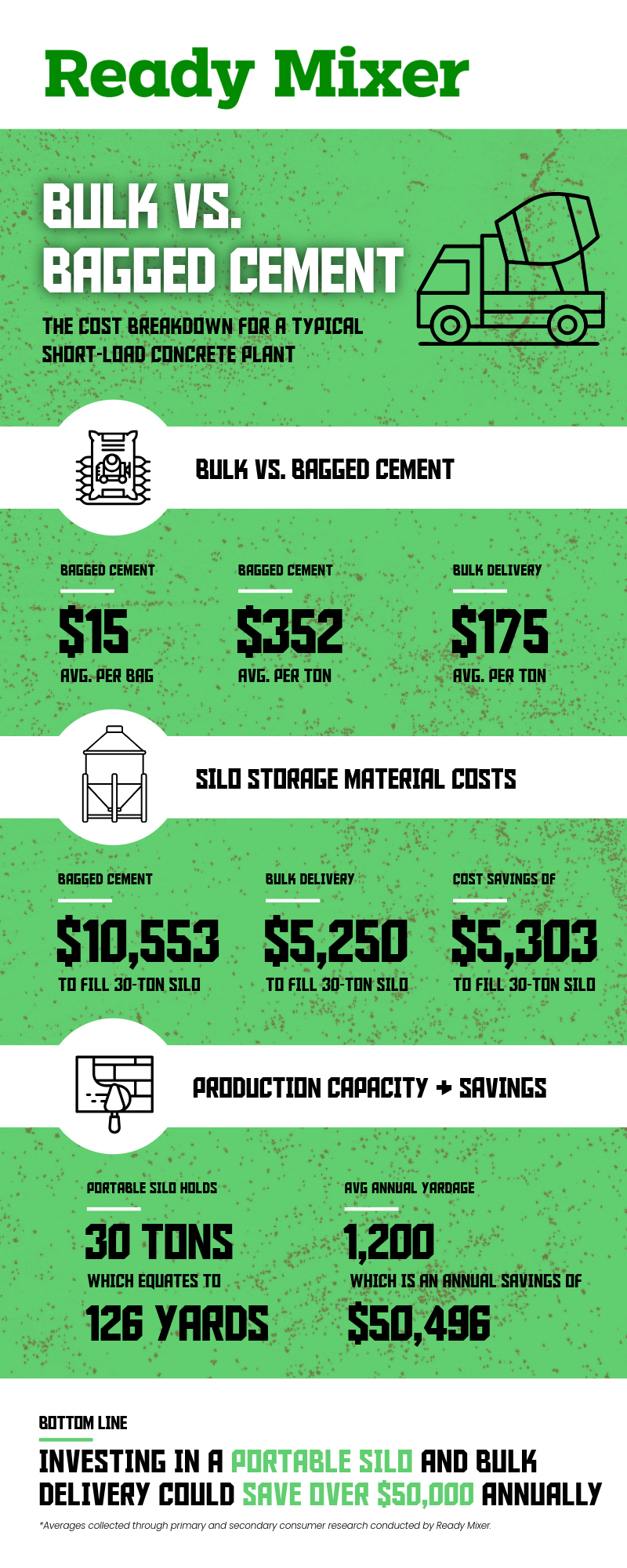
On average, a 94 lb. bag of cement costs around $15. Multiply that out and you’re paying approximately $352 per ton. Now compare that to bulk cement delivery, which averages around $175 per ton. That’s a 50% savings every time you fill your cement silo.

Silo Fill Costs: The Savings Are Clear

A standard portable cement silo holds 30 tons. Given the average costs calculated above, here’s what it costs to fill a silo with each option:

  • Bagged Cement: $10,553

  • Bulk Cement: $5,250

  • Savings Per Fill: $5,303

Even if you’re operating on a smaller scale, those savings stack up quickly. Most short-load plants go through around 1,200 yards of concrete per year, requiring about 9–10 full cement silo fills.

That translates into a total annual savings of $50,000 or more just by switching to bulk cement and silo storage.

Why a Cement Silo is a Smart Investment

The idea of adding a cement silo might seem like a big capital expense—but it’s an investment that pays for itself in less than a year for most operators.

Beyond cost savings, a cement silo also improves operational efficiency. It reduces manual labor, minimizes downtime from bag handling, and improves site cleanliness. Plus, bulk delivery is far more consistent and scalable as your business grows.


Bottom Line

If you’re still operating your plant with bagged cement, you’re not just spending more—you’re working harder to produce less.

By upgrading to a cement silo and switching to bulk delivery, short-load operators can significantly reduce costs, increase efficiency, and boost their bottom line.

📊 Check out the infographic above for a full cost breakdown.

💡 Interested in adding a portable cement silo to your operation? Let’s talk about how Ready Mixer can help you save time, money, and hassle—starting today.

Concrete Corrosion: How to Spot It, Prevent It, and Fix It Before It Costs You

Concrete is built to last—but corrosion from the elements is a silent enemy that can compromise everything. For concrete contractors, foremen, and rental equipment business owners, the safety and integrity of your finished product is paramount. When corrosion sets in, understanding the causes, warning signs, and repair options is critical to protecting your projects, your reputation, and your bottom line.

This guide will help you:

  • Spot early signs of concrete corrosion
  • Prevent damage before it starts
  • Take action when corrosion has already taken hold

Let’s dig into the strategies you can use on the job site to stay ahead of the curve.

What Is Concrete Corrosion?

Concrete corrosion refers to the deterioration of embedded steel reinforcement due to chemical reactions, often involving moisture and oxygen. When this rebar rusts, it expands, putting pressure on the surrounding concrete and leading to cracking and structural failure.

Common Causes of Concrete Corrosion

  • Moisture infiltration: Trapped water within the concrete matrix initiates an electrochemical reaction that leads to rebar oxidation and expansion, ultimately causing cracking and delamination.
  • Abrasive erosion: Wastewater often carries abrasive materials like sand, rocks, silt, or ice. When water flow is unstable, these materials repeatedly hit the concrete surface, wearing it down over time and creating a smooth, polished wear pattern.
  • Chlorides (salt): Frequently introduced via de-icing salts or seawater, chlorides penetrate concrete and break down the passive oxide layer protecting rebar, accelerating corrosion.
  • Carbonation: When carbon dioxide from the air reacts with calcium hydroxide in the concrete, it lowers the pH, weakening the protective environment around the steel reinforcement.
  • Chemical exposure: Industrial environments or contact with aggressive chemicals like acids or sulfates can rapidly degrade concrete and compromise its ability to shield embedded steel.

Why It Matters

  • Loss of structural integrity
  • Increased liability and repair costs
  • Safety hazards on job sites
  • Reduced lifespan of equipment or structures

How to Spot Early Signs of Concrete Corrosion

Concrete doesn’t always scream for attention when it’s in trouble—but there are several signs to look for:

Common Indicators

  • Cracking: Hairline or spider cracks near rebar lines.
  • Spalling: Concrete flaking or chipping due to pressure from corroding steel.
  • Rust stains: Brown or reddish streaks on the surface often point to corroded rebar.
  • Efflorescence: A white, powdery residue from soluble salts brought to the surface.
  • Hollow sounds: Tap on concrete; a hollow sound suggests delamination.
  • Exposed rebar: Metal reinforcement visible or protruding from the concrete.

Inspection Checklist

  1. Walk-through inspections monthly or quarterly
  2. Tap testing on suspect areas
  3. Documenting cracks and changes over time
  4. Using infrared thermography or GPR (ground-penetrating radar)

Call in a structural engineer or NDT (non-destructive testing) professional for deeper evaluations if needed.

How to Prevent Concrete Corrosion

Prevention starts at the mix design phase and extends through job site practices and ongoing maintenance. Here’s how to protect your concrete for the long haul:

  1. Use High-Quality Concrete Mixes: Low water-to-cement ratio improves durability. Check out our guide to picking the right ratio for your job here. You may also choose to use blended cements and supplementary cementitious materials (like fly ash or slag).
  2. Cure Properly: Maintain moisture for 7+ days post-pour or use curing compounds or wet coverings.
  3. Apply Protective Coatings: Epoxy, polyurethane, or silane sealers resist moisture and chemicals.
  4. Use Corrosion-Inhibiting Admixtures: Calcium nitrite or organic inhibitors protect rebar internally.
  5. Ensure Proper Drainage: Slope surfaces and install drains to direct water away from the concrete. Prevent water from pooling near footings or slab edges.
  6. Conduct Routine Maintenance: Annual or quarterly inspections, resealing every few years and cleaning and debris removal can go a long way to prolong the life of your work.

Equipment Rental Tip

If you rent or lend concrete tools or mixers, clean them thoroughly between uses. Residual chemicals and moisture can speed up deterioration.

How to Fix Concrete Corrosion When It Happens

If corrosion has already set in, don’t panic. There are proven methods to fix the damage:

  1. Remove Damaged Concrete: Use chipping hammers or hydrodemolition to remove deteriorated concrete and fully expose any corroded rebar.
  2. Clean and Treat the Rebar: Rust should be removed using wire brushing or sandblasting. Once clean, apply corrosion inhibitors or zinc-rich primers to protect the exposed steel.
  3. Apply Bonding Agents: A bonding agent ensures that the new repair material properly adheres to the existing concrete surface.
  4. Patch with Repair Mortars: Polymer-modified or fiber-reinforced mortars are ideal for rebuilding the damaged area with enhanced durability and strength.
  5. Install Cathodic Protection: For high-value or mission-critical structures, install cathodic protection systems—either sacrificial anodes or impressed current—to counteract the electrochemical process causing corrosion.
  6. Know When to Repair or Replace: If more than 25% of the rebar cross-section is lost to corrosion, a structural engineer should be consulted to evaluate if replacement is safer and more cost-effective.
  7. Partner with Pros: Large-scale repairs often require the expertise of concrete restoration specialists who have the tools, materials, and experience to ensure lasting results.

Real-World Impact—What’s at Stake if You Ignore It

Ignoring corrosion doesn’t just cost money—it can cost lives and livelihoods. A stark example of this occurred in 2006, when Boston’s Big Dig tunnel experienced a ceiling collapse due to corrosion-related anchor failure, tragically resulting in a fatality. Beyond isolated incidents, the scale of the problem is enormous: the Biden-Harris Administration in the United States dedicated $40 billion over five years to tackle bridge improvement projects alone. Moreover, contractors who overlook corrosion risks may face serious legal and financial consequences, including OSHA fines and litigation stemming from preventable job site injuries.

Tools, Products & Resources That Help

Top Product Types

  • Rebar coatings (epoxy-coated or galvanized rebar)
  • Penetrating concrete sealers
  • Fiber-reinforced patching materials
  • Calcium nitrite-based admixtures

Inspection Tools

  • Rebound hammers
  • Ultrasonic pulse velocity testers
  • Infrared thermography devices

Recommended Resources

Pro Tip: Ready Mixer tools help ensure clean, consistent concrete batching and placement—key to reducing future corrosion. See Ready Mixer solutions here.

Build Strong. Stay Smart.

Concrete corrosion isn’t a matter of if—it’s when. But with knowledge and preparation, you can stay ahead of the damage.

Stay proactive

  • Inspect regularly
  • Invest in quality materials
  • Repair at the first sign of trouble

And always remember: protecting your work protects your reputation.


Want more job site wisdom? Subscribe to The Mix, Ready Mixer’s monthly newsletter, for insights that keep your crew ahead of the game.

Ten Essential Safety Tips for Ready Mix Crews

Safety on a ready-mix site is no accident – it’s the result of planning, paying attention, and acting safely. Heavy mixers and site equipment create many hazards, so every team member must Think First before each task. The National Ready Mixed Concrete Association’s “Think First” campaign reminds us that common-sense habits save lives. Below are 10 easy-to-remember tips for ready mix crews – each backed by official safety guidance – to help you and your team stay safe.

Listen

Noise on the job can be intense around mixers, trucks, and saws, so protecting your hearing is crucial. In construction, about half of workers face dangerously loud noise, and many skip ear protection. Lost hearing isn’t just about long‐term health; if you can’t hear alarms, horns or coworkers’ warnings, you can miss hazards. OSHA notes that consistent use of hearing protection and monitoring can prevent irreversible damage. Listen up: When you hear a backup alarm, get clear of the truck. Before you start, double-check that your radio or intercom is working and turned up so you can hear instructions and alerts over background noise.

Safety Tip

Always wear earplugs or muffs when equipment is running, and make sure you can hear horns, beepers and spoken instructions. Treat hearing protection as part of your kit – it keeps you focused and able to “listen first.”

Communicate

Good communication is a safety tool. On busy sites with trucks coming and going, clear signals and brief talks keep everyone on the same page. OSHA emphasizes that all workers should know the hazards on site and how to control them. Before a pour or any task, hold a quick huddle – confirm who’s doing what, identify dangers (like moving vehicles or pump hoses), and agree on hand signals or radios. Call out any problems immediately: if a co-worker is in a blind spot or a mixer’s chute is swinging, shout a warning or sound the horn to keep your crew safe. Effective communication (including questions and feedback) makes sure no one is caught off-guard.

Safety Tip

Have a plan for communicating – use two-way radios or hand signals for spots where you can’t see each other. Always report hazards (for example, “Stop – form collapse!”) so everyone can fix the problem before someone gets hurt.

Sober Working is Safe Working

Operating a mixer or pump under the influence of drugs or alcohol is both illegal and dangerous. OSHA strongly supports drug-free policies for safety-sensitive work like driving heavy equipment. In fact, federal motor carrier rules flatly forbid it: no driver may be on duty with any detectable amount of alcohol or impairing drug in their system. Working tipsy or on drugs slows your reactions and impairs judgment, and that’s how injuries happen. Whether it’s an after‐work drink or prescription medicine, if it makes you drowsy or fuzzy, stay off the truck. Employers must keep workplaces free of “employees performing duties… under the intoxicating influence of alcohol or illicit drugs.”

Safety Tip

Arrive to work clear-headed and well-rested. If you feel “off” or you’re taking any medication that can cause drowsiness, tell your supervisor before climbing in. Never consume drugs or alcohol within hours of driving a ready-mix truck.

Always Wear Your Seatbelt

It might seem obvious, but buckling up is your first line of defense in a collision or tip-over. Federal law is crystal clear: “No driver shall operate a commercial motor vehicle… unless the driver is properly restrained by the seat belt assembly.” In other words, it’s not optional – it’s the law. Seat belts saved over 14,900 lives in 2017 alone. Even on short drives or slow backs on site, wearing a seat belt keeps you from being thrown against the cab interior or ejected.

Safety Tip

Buckle up immediately when you get in the truck. Make it a habit: click the belt before turning on the engine. Remind any passengers to buckle up too – they are required to wear belts in property-carrying trucks just like you.

Make Your First Move Forward

Backing accidents kill, especially in construction. OSHA highlights that over 70 workers died in a single year from backover incidents – when a vehicle reversed into someone. One NIOSH study found 143 workers were fatally struck by vehicles backing up between 2003–2010 (with 84 of those by dump or mixer trucks). One simple way to reduce this risk is the “First Move Forward” strategy: whenever possible, park so you can leave by driving forward, not reverse. That way, when your shift or pour is done, your first move will be out of a spot instead of backing up blindly.


Before you ever put the truck in reverse, stop and check your surroundings. Walk the backup path – look for people or obstacles. Use a spotter: have a co-worker stand where they can see blind spots and direct you. Keep your backup alarm on (they are required by law in many cases). If you need to reverse, back slowly, looking over both shoulders and at the mirrors. OSHA’s advice is clear: backovers are preventable, so take these precautions each time.

Safety Tip

Whenever you arrive or park, position the truck to pull forward out. If you must back up, use a spotter and backups alarms, and never rely only on mirrors. Always give yourself a clear view – this first move forward habit greatly cuts down on blindside accidents.

Know the Hazards Before Starting a Task

Every job has risks – from falling rebar to rotating drum parts. OSHA notes that failing to recognize hazards is a “root cause” of many injuries. That means it pays to stop and ask, “What could go wrong here?” before you begin. Do a quick walkthrough: check for slippery surfaces, unsecured materials, overhead cranes or energized equipment. Review any required permits or pre-job checklists. If a task seems unfamiliar or risky, ask a supervisor for guidance.


This hazard check should be routine. For example, before cleaning inside a mixer drum or servicing a pump, confirm the drum is locked out and the chutes are in a safe position. If you’re pouring concrete, note which way it will flow and plan your exit paths. Identifying the dangers in advance gives you time to control them – like moving tripping hazards, barricading high-traffic areas, or ensuring fall protection is in place. OSHA’s recommended practices urge employers and workers to proactively identify and assess hazards so injuries can be prevented.

Safety Tip

Always do a quick hazard hunt before each job. Talk it through with your crew, point out known dangers, and make sure everyone knows how to avoid them. A brief safety talk (toolbox talk) can highlight hazards and keep everyone alert.

Personal Protective Equipment (PPE) Only Works When Used

Hard hats, safety glasses, gloves, high-vis vests, steel-toed boots – you know the gear. But PPE only protects you if you actually wear it and wear it correctly. OSHA requires employers to provide the right PPE and ensure employees use it. On a ready-mix site, that means hard hats on at all times, eye protection when chipping or dealing with fly ash, dust masks when cleaning trucks, and any other gear needed for the task.

Don’t treat PPE like optional extra baggage – treat it like part of your uniform. Inspect your equipment each day: cracked goggles or worn earplugs need immediate replacement. If a co-worker isn’t wearing required PPE, speak up. Remember, inconsistent safety policies are dangerous: OSHA warns that if some workers skip hats or vests, others might mistakenly do the same and get hurt. Wearing PPE might seem cumbersome, but it stops cuts, chemical splashes, impacts, and more – exactly what we need on a concrete site.

Safety Tip

Gear up fully before every task. Make PPE the first thing you put on at work. Regularly check your helmet, glasses, and other gear for damage, and don’t start work until every person has their PPE properly in place.

Always Use Three Points of Contact

Getting in and out of a mixer truck or climbing a ladder means you need stability. OSHA calls it the three points of contact rule: keep two feet and one hand (or two hands and one foot) on the vehicle/ladder at all times when climbing or descending. This rule helps prevent falls and crush injuries from slips. For example, when stepping onto a rear mixer platform or ladder, never hold a tool in both hands – keep at least one hand free to grip a rung or rail.

Even if you’ve done it a hundred times, don’t take shortcuts like jumping off, standing on machinery parts, or carrying coffee while sliding down the ladder. Hold onto the handrail with one hand and face the ladder as you climb; use the designed steps and handholds on trucks. This isn’t OSHA just being picky – their ladder standards explicitly aim to keep you in three-point contact when climbing. By always using three points of contact, you dramatically reduce fall risks.

Safety Tip

When mounting or descending trucks and equipment, always have two limbs on the ladder or steps and one hand holding a rail. If you need to carry something, put it in a bucket or hand it up after you’re positioned safely.

The Dangers of Shortcuts

Cutting corners to save time can have deadly consequences. OSHA recounts cases where “working out of sequence” or skipping a step led to severe injuries. In one report, a worker bypassed a safety step and lost fingers when the machine wasn’t properly shut down. It’s human nature to rush a task, but that’s when accidents happen. If procedures say to lock out power or set the brakes, do it every time – there’s no excuse when lives are at stake.

For instance, don’t skip walking around to spot trip hazards before moving a truck. Don’t ignore a cracked ladder rung because you’re in a hurry. If instructions say to lower a chute slowly, do it – jerking it down might seem faster, but it risks breaking equipment or hurting someone. Remember the OSHA case: even though procedures were available, the worker admitted his injury “was a result of his cutting corners”.

Safety Tip

Follow every safety step, no matter how minor it seems. Take the extra 10 seconds to turn off and lock out machinery, double-check clearances, or slow down the pour. Skipping these steps is never worth the risk.

Stay Alert and Focused

Distractions and fatigue are hidden killers on the road and the site. OSHA warns that any non-driving task – texting, eating, even deep conversation – takes your focus off the vehicle and increases crash risk. On-site, a moment’s lapse (like checking a phone) can mean missing a co-worker stepping behind your truck. Similarly, drowsy driving is basically impaired driving in disguise. OSHA notes that being awake 24 hours straight has the same effect on reflexes as a blood-alcohol level of .10.

Concrete crews often work long hours, but you must know your limits. If you’re yawning or find your mind wandering, pull over at the next break for coffee or a rest. Rotate tasks to avoid monotony – a short break to stretch or drink water can reset your focus. Store mobile phones out of reach while driving or use hands-free if needed for job-critical calls. The bottom line: keep your eyes on the task (or road) and your mind in the present.

Safety Tip

Stay disciplined: silence personal distractions and take regular rest breaks. If you feel tired, ask for help or let dispatch know. Remember OSHA’s warning: fatigue blurs your alertness like alcohol would.

Think First – Keep Safety in Mind

Every tip above ties back to one mindset: Think First. Pause and ask “What could go wrong?” before lifting a hose, stepping on a platform, or hitting the ignition. As the NRMCA emphasizes, having the whole workforce think first decreases injuries and fatalities and builds positive morale on site. When you make these safety habits – listening for warnings, talking with your crew, staying sober and alert, and never cutting corners – second nature, they become part of your routine. In turn, the job site becomes safer for everyone, and we all go home in one piece.

Stay sharp, stay safe, and always Think First.